Whitening science
Why whitening makes teeth hurt — and what actually helps
Sensitivity is the main reason people abandon a whitening round. The mechanism is better understood than most product copy admits, and several of the standard fixes are weaker than they are sold as.
Dr. Dave Steuer, D.M.D., Ph.D. · October 4, 2026 · 6 min read
Sensitivity is the dominant side effect of tooth whitening. The American Dental Association puts it plainly: transient mild to moderate tooth sensitivity can occur in up to two-thirds of users during the early stages of bleaching. For tray and strip treatments it typically begins around day two or three and resolves within a few days of finishing.
That is worth stating clearly, because a lot of whitening marketing implies sensitivity is a defect of other products. It isn't. It is a property of the chemistry, and the useful question is not whether it happens but how much peroxide you needed to get the result.
It is not simply "open tubules"
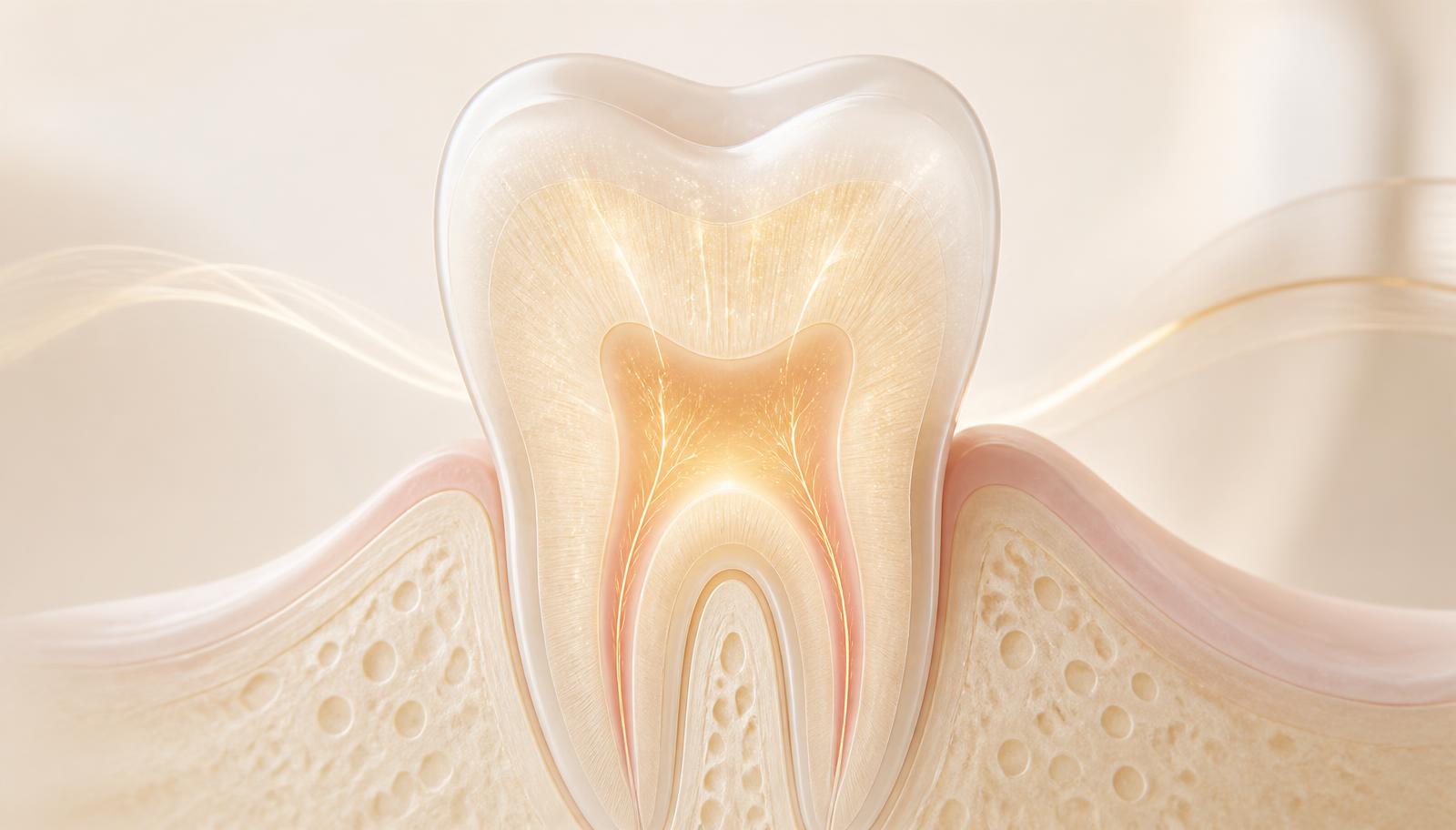
The popular explanation is that whitening opens dentinal tubules and lets stimuli reach the nerve. That is incomplete. Peroxide diffuses through enamel and dentin and reaches the pulp itself. A 2024 systematic review of in vivo studies found that high-concentration hydrogen peroxide gels produced a moderate-to-strong inflammatory response in pulp tissue with genuine cell damage, and tertiary dentine formation on longer follow-up.
So whitening sensitivity behaves less like ordinary hydrodynamic sensitivity and more like a reversible, low-grade pulpal inflammation. That reframes what to do about it. The goal is less peroxide reaching the pulp — not just sealing the surface.
The one lever with consistent evidence behind it
Concentration. Higher peroxide means more sensitivity, and this dose-response is the most consistent finding across the literature. It appears in the Cochrane review of home whitening and in the ADA's own guidance.
It follows that the honest way to reduce sensitivity is to use less peroxide and accept that the result arrives over more sessions rather than fewer. That is a less exciting promise than most of this category makes.
Potassium nitrate does something. It does less than it is sold as doing.
Potassium nitrate is the standard desensitizing answer, and it is in a great many products. A 2021 systematic review and meta-analysis found a real, statistically significant effect: a 12% relative reduction in sensitivity risk, and a reduction in intensity of about a third of a point on a visual analogue scale.
Then the authors said something the marketing never quotes. They described the clinical significance of that reduction as "subtle and clinically questionable." A third of a point on a ten-point scale may be measurable without being noticeable. The ADA's position is consistent with this — it states that further research is needed to confirm the efficacy of pretreatment approaches including potassium nitrate.
The defensible claim is that potassium nitrate modestly reduces sensitivity, possibly below the threshold at which you would perceive the difference. The claim that it prevents whitening sensitivity is not supported.
And several topical agents do nothing measurable
A 2024 systematic review and meta-analysis of randomized trials tested topically applied drugs for in-office bleaching sensitivity — including nanoencapsulated eugenol, ibuprofen with arginine, and dipyrone. None significantly reduced sensitivity at one hour, twenty-four hours, or forty-eight hours, at moderate certainty of evidence.
The category "desensitizing agent" is not a guarantee of anything. Individual agents have to earn it individually, and several have not.
One piece of good news
You are not trading whiteness for comfort. Across these reviews, desensitizing agents did not impair colour change. Whatever you do to manage sensitivity, it does not appear to cost you the result — so the framing of comfort versus outcome, which shows up constantly in product copy, is not supported by the evidence.
How certain is any of this
Less than you would like. The Cochrane review rated the certainty of evidence as low to very low across all comparisons, driven by small single trials and unclear risk of bias. Sensitivity is also measured inconsistently between studies — incidence versus intensity, different scales, different timepoints — which makes pooling fragile.
We would rather say that than imply a settled science that does not exist.
What this leaves you with
Lower concentration and shorter contact time, spacing sessions out, and finishing the round rather than pushing through discomfort. We should be straight about the status of that advice: the concentration part is well supported, but we could not find a well-conducted review isolating daily wear time or days between sessions as independent variables. Those are mechanistically consistent with the dose-response and clinically reasonable, but they are extrapolation rather than direct evidence, and we would rather label them that way than dress them up.
If sensitivity is severe, persists well beyond a few days after you stop, or is localized to one tooth rather than general, that is not whitening sensitivity and it is worth having looked at.
References
- [1] American Dental Association. Oral Health Topics: Whitening. Last updated 16 August 2022.
American Dental Association
- [2] Eachempati P, Kumbargere Nagraj S, Kiran Kumar Krishanappa S, Gupta P, Yaylali IE. Home-based chemically-induced whitening (bleaching) of teeth in adults. Cochrane Database of Systematic Reviews. 2018;(12):CD006202.
Cochrane
- [3] Donato MV, dos Reis-Prado AH, Abreu LG, et al. Influence of dental bleaching on the pulp tissue: a systematic review of in vivo studies. International Endodontic Journal. 2024.
International Endodontic Journal
- [4] Martini EC, Favoreto MW, Rezende M, de Geus JL, Loguercio AD, Reis A. Topical application of a desensitizing agent containing potassium nitrate before dental bleaching: a systematic review and meta-analysis. Clinical Oral Investigations. 2021;25(7):4311–4327.
Clinical Oral Investigations
- [5] de Oliveira FJD, Costa MJF, de Bessa MS, Borges BCD. Efficacy of topical drug application to manage in-office bleaching sensitivity: a systematic review and meta-analysis of randomized clinical trials. Clinical Oral Investigations. 2024;28:452.
Clinical Oral Investigations
This page is educational and is not a substitute for individual dental advice. Consult your dentist before whitening if you have untreated decay, active gum disease, or extensive restorations on visible teeth.