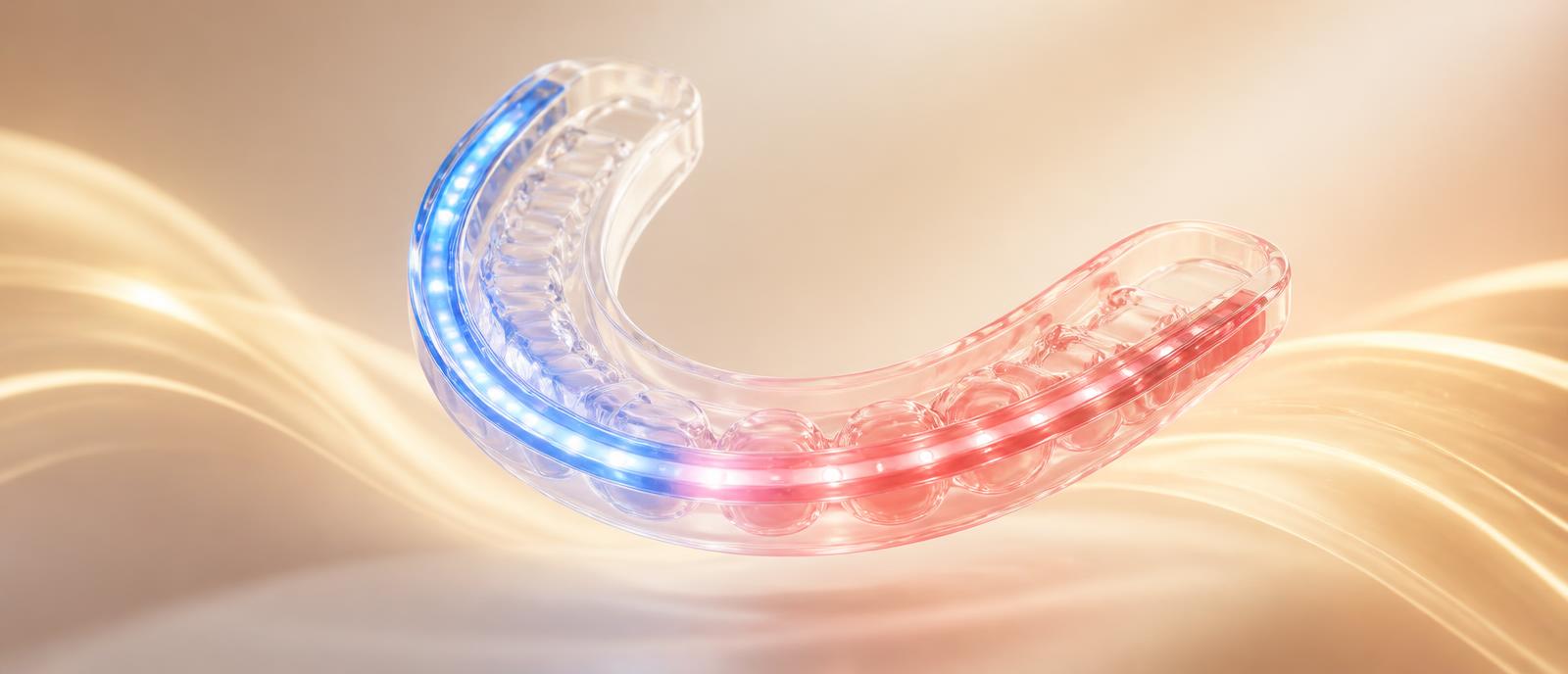
Whitening science
Why the light is two colors
Two wavelengths and a ten-minute session. The short session is doing more work than either light — here is what each part is actually for, including where the evidence does not support what this category usually claims.
Dr. Dave Steuer, D.M.D., Ph.D. · August 30, 2026 · 7 min read
If you have ever looked at an LED tray and wondered whether the light is doing real work or just looking expensive, that is a fair question. It deserves a straight answer, including the part of the answer that is inconvenient for us.
What is actually changing color
Whitening is an oxidation reaction inside enamel, not bleach painted onto a tooth. Carbamide peroxide breaks down into hydrogen peroxide, which releases reactive oxygen species that cleave the double bonds in chromogens — the pigment molecules that make a tooth look darker. The fragments reflect light differently. The mineral structure of the enamel is not the target of the reaction.
That reaction has a rate. Like any chemical reaction, it depends on concentration, on how long the gel sits against the tooth, and on whether you actually finish the session.
What the blue light is for
Blue light in the mid-400s nanometre range is what nearly every whitening system pairs with peroxide, and the reasoning is intuitive: light adds energy to a reaction, and some pigment molecules absorb in that range.
Here is where we are going to be more careful than this category usually is.
Systematic reviews that compared the same bleaching gel with and without light have not found that the light produces more colour change. SoutoMaior and colleagues, pooling twenty randomised trials, concluded that light sources are "not imperative to achieve clinical esthetic results." A larger review by Maran and colleagues found that light activation "does not seem to improve color change... regardless of the hydrogen peroxide concentration." A 2026 umbrella review of those reviews reports no clinically meaningful improvement from routine light activation.
Those studies looked at in-office bleaching at professional concentrations, which is not the same thing as a low-concentration tray worn at home — the at-home evidence base is thinner in both directions.
So we will put it plainly. Whatever the blue channel contributes is a bonus on top of the chemistry. It is not the reason this system works, and we are not going to sell it to you as though it were. The gel does the whitening.
Why ten minutes
This matters more than either wavelength, and it is the actual design decision behind the protocol.
Sensitivity from peroxide is not only a function of how strong the gel is. It is a function of how long peroxide stays in contact with the tooth, session after session. Cumulative contact is what produces the zingers, and contact time is the lever we chose to pull.
Ten minutes a day across a few more days is easier on a tooth than fifteen minutes across fewer days, for a comparable amount of shade movement. Shorter exposure, repeated, beats longer exposure compressed into a short course. That is the whole reason the session is ten minutes rather than a number that sounds more impressive.
We should be straight about the status of that reasoning. The relationship between peroxide concentration and sensitivity is well documented in the literature. Wear time per session, isolated as its own variable, is much less studied — this is clinical judgment from someone who spends his working life inside teeth, and mechanistic reasoning that follows from the concentration data. It is not something we can point at a randomised trial for, and we would rather tell you that than imply a citation we do not have.
What the red light is for
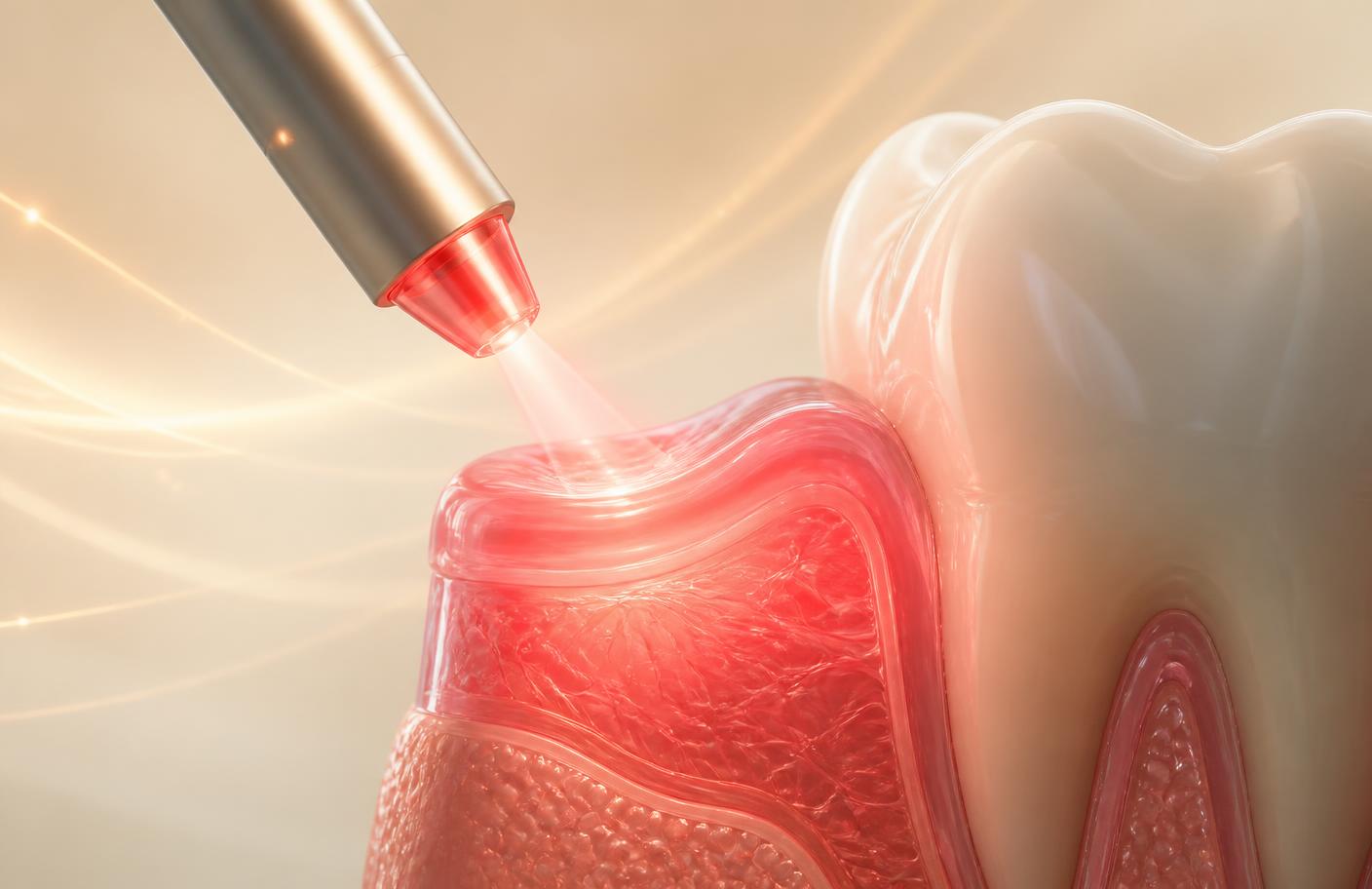
Red light in the 620–660 nm range is a different assignment, and this is where the evidence is actually on our side.
Red and near-infrared light applied to tissue is studied under the heading of photobiomodulation. A 2022 meta-analysis of placebo-controlled trials found that it significantly reduced pain after each of the first three bleaching sessions, and did so "without impairing" the colour result. Two further systematic reviews point the same direction while noting honestly that the trials are few, small, and difficult to blind.
There is a second signal worth mentioning, from the same review that found no colour benefit: SoutoMaior and colleagues reported that sensitivity intensity was lower when light sources were used, even though the incidence was unchanged.
Put the pieces together and the system reads clearly. The gel does the whitening. The short session is what protects the tooth from cumulative peroxide contact. The red channel is what keeps that short session comfortable enough that you complete the course rather than quitting three days in. Sensitivity is the single most common reason people abandon a whitening round — a protocol you finish beats a protocol you quit.
If you have sharp pain, untreated decay, or you cannot complete a session, that is a dentist visit. It is not a brighter LED.
What you actually do
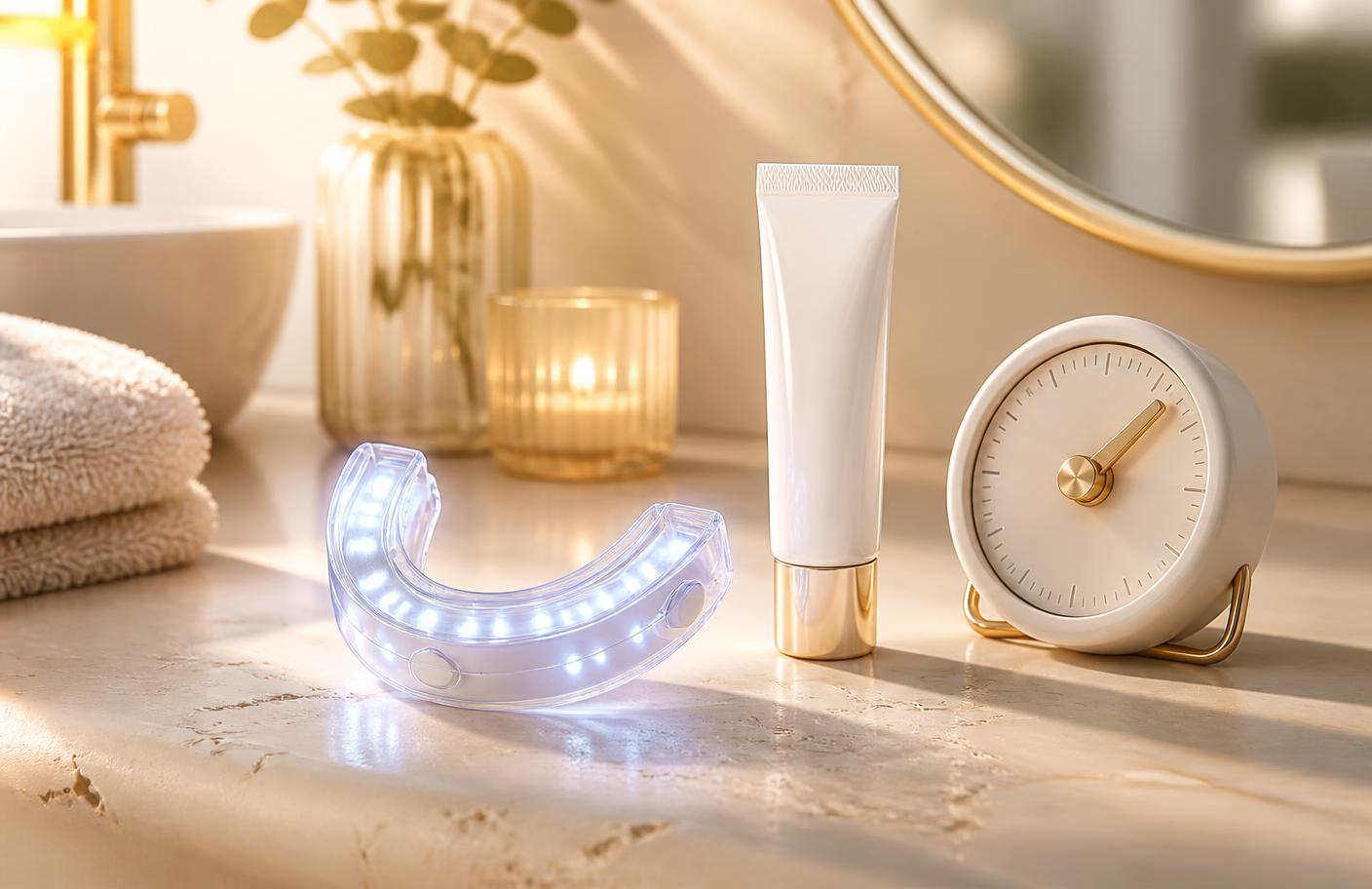
Brush, load the tray with gel, wear it for ten minutes, then maintain. Visible change often shows within a few days. A fuller shift takes the better part of two weeks, and it varies with your starting shade and your habits.
Finish the session. An abandoned twenty-minute ritual loses to ten minutes you will actually do.
What this does not do
Whitening lightens natural enamel and dentin. It does nothing to porcelain, ceramic, zirconia, veneers, composite bonding or implant crowns — those materials have no chromogens to break and no porosity for peroxide to diffuse into.
A new shade is also not a permanent freeze-frame. Within minutes of any cleaning, salivary proteins reform the acquired enamel pellicle, and pigment binds to that film again. Maintenance is biology, not a product failure.
And some dark lines along the gum margin are not pigment inside enamel at all — they are produced by chromogenic bacteria in the oral microbiome. Peroxide does very little to those. That is a cleaning problem, not a brighter-light problem.
References
- [1] SoutoMaior JR, de Moraes SLD, Lemos CAA, do Egito Vasconcelos BC, Montes MAJR, Pellizzer EP. Effectiveness of light sources on in-office dental bleaching: a systematic review and meta-analyses. Operative Dentistry. 2019;44(3):E105–E117. — Note: 20 randomised trials pooled; concluded light sources are not imperative for clinical esthetic results, with no difference in colour change, but lower sensitivity intensity when light was used.
Operative Dentistry · 2019
- [2] Maran BM, Burey A, de Paris Matos T, Loguercio AD, Reis A. In-office dental bleaching with light versus without light: a systematic review and meta-analysis. Journal of Dentistry. 2018;70:1–13. — Note: No significant difference in colour change or sensitivity regardless of hydrogen peroxide concentration; evidence graded moderate for colour change.
Journal of Dentistry · 2018
- [3] Hajeer O, Hasan A. In-office tooth bleaching protocols: an umbrella review of systematic reviews and meta-analyses on whitening efficacy and tooth sensitivity. Saudi Dental Journal. 2026;38(4):39. — Note: Reports no clinically meaningful improvement in whitening efficacy from LED, halogen or laser activation compared with chemical-only protocols.
Saudi Dental Journal · 2026
- [4] Silva PGB, Cetira Filho EL, Nigri FMN, Dantas TS, Candeiro GTM, Neri JR. Photobiomodulation reduces pain-related symptoms without interfering in the efficacy of in-office tooth bleaching: a systematic review and meta-analysis of placebo-controlled clinical trials. Photobiomodulation, Photomedicine, and Laser Surgery. 2022;40(3):163–177. — Note: Photobiomodulation significantly reduced sensitivity after each of the first three sessions without impairing colour change.
Photobiomodulation, Photomedicine, and Laser Surgery · 2022
- [5] Giannakopoulou P, Neophytou C, Karakostas P, Papadimitriou K, Dionysopoulos D, Tolidis K, Davidopoulou S. Low-level laser therapy for tooth sensitivity after tooth bleaching: a systematic review. Applied Sciences. 2024;14(17):8068. — Note: Six trials at 660–900 nm; appears to reduce post-bleaching sensitivity, but heterogeneity prevented meta-analysis and all trials had bias concerns.
Applied Sciences · 2024
- [6] Carey CM. Tooth whitening: what we now know. Journal of Evidence-Based Dental Practice. 2014;14 Suppl:70–76. — Note: Peroxide diffuses through enamel and dentin and oxidises pigmented organic molecules.
Journal of Evidence-Based Dental Practice · 2014
- [7] Lendenmann U, Grogan J, Oppenheim FG. Saliva and dental pellicle — a review. Advances in Dental Research. 2000;14:22–28. — Note: Formation of the acquired enamel pellicle and its role as the interface between tooth surface and oral environment.
Advances in Dental Research · 2000
- [8] Chromogenic bacterial staining of teeth: a scoping review. BMC Oral Health. 2025. — Note: Bacterially produced dental black stain, its microbial associations, and its recurrence after cleaning.
BMC Oral Health · 2025
This page is educational and is not a substitute for individual dental advice. Consult your dentist before whitening if you have untreated decay, active gum disease, or extensive restorations on visible teeth.